


Crypto Arbitrage Tutorial: Step-by-Step Beginner Guide
Crypto arbitrage tutorial - you've heard it's possible to profit from price differences across exchanges, but where do you actually start? This step-by-step guide walks you through everything you need to execute your first arbitrage trade, from setting up accounts to calculating real profits after fees.
In this tutorial, you'll learn:
- How crypto arbitrage works (the 60-second version)
- Three types of arbitrage strategies for beginners
- Step-by-step instructions for your first trade
- Essential tools to find opportunities faster
- Common risks and how to avoid them
Reading time: 12 minutes
Important Disclaimer
This content is for educational purposes only and does not constitute financial, investment, or trading advice. Cryptocurrency arbitrage involves significant risks including potential loss of capital. Always conduct your own research and consult with qualified financial advisors before trading.
What is Crypto Arbitrage? (Quick Overview)
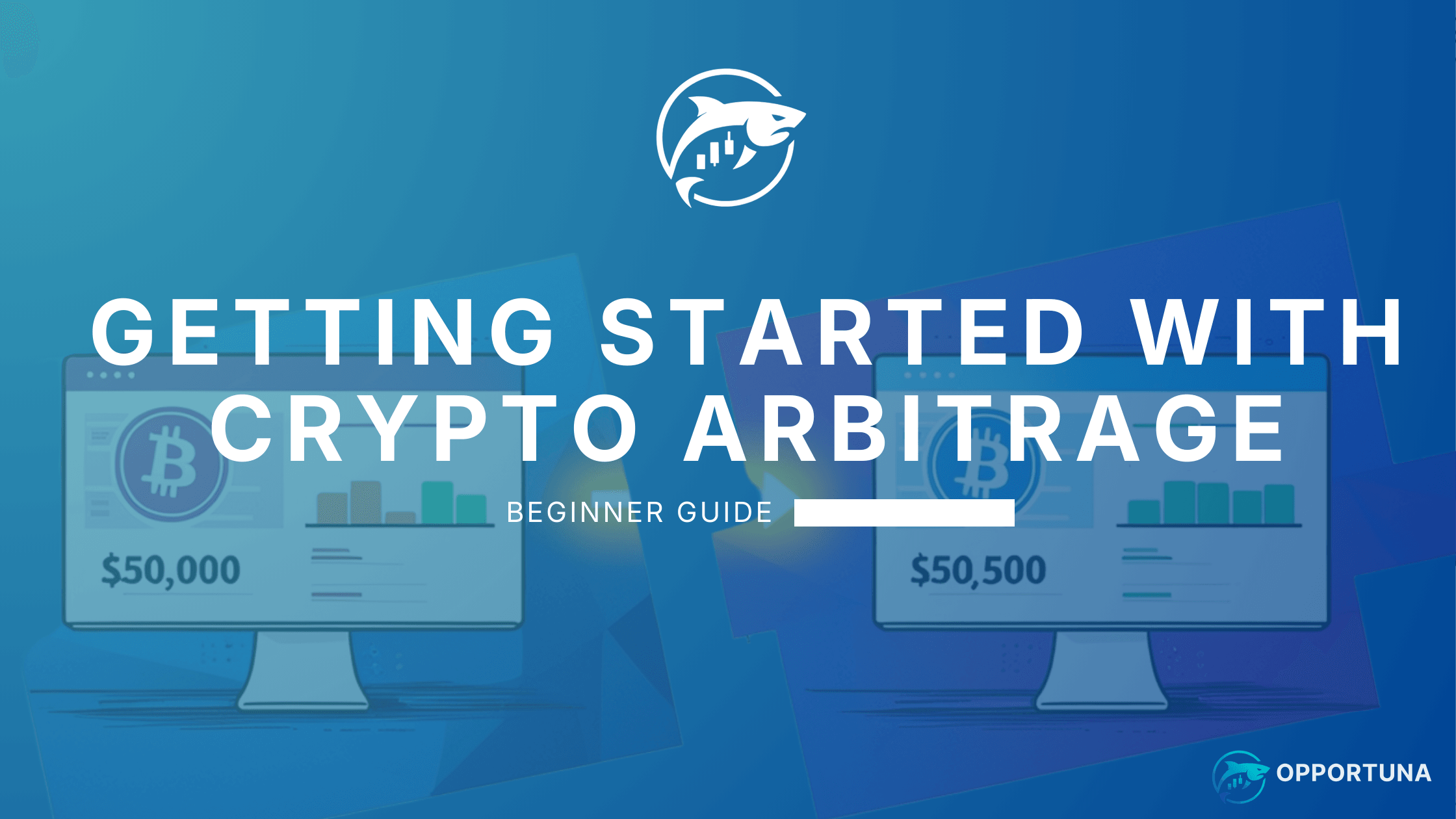
Crypto arbitrage is a trading strategy that exploits price differences for the same cryptocurrency across different exchanges or markets. You buy where it's cheaper, sell where it's more expensive, and pocket the difference.
For example: Bitcoin trades at $95,000 on Exchange A and $95,400 on Exchange B. Buy on A, sell on B, and you've made $400 per BTC (minus fees).
Information
Want the deep dive? This tutorial focuses on how to get started. For a comprehensive explanation of arbitrage mechanics, check out our complete guide to crypto arbitrage.
Is Crypto Arbitrage Still Profitable in 2026?
Yes - but it requires the right approach. Here's why opportunities still exist:
- 24/7 markets: Unlike traditional finance, crypto never closes. Price inefficiencies occur around the clock, especially during high volatility periods.
- Fragmented liquidity: With hundreds of exchanges worldwide, prices don't always sync immediately.
- New tokens and exchanges: Emerging markets and recently listed tokens often have larger price gaps due to lower liquidity.
- DeFi growth: Decentralized exchanges (DEXs) with algorithmic pricing create additional arbitrage opportunities.
The catch? Manual arbitrage is slow. Most profitable traders use scanners and automation to spot opportunities before they disappear - often within seconds.
Types of Arbitrage for Beginners
Not all arbitrage strategies are equal. Here are three approaches ranked by complexity:
1. Spot Arbitrage (Easiest)
Spot arbitrage (also called spatial or cross-exchange arbitrage) is the simplest form. You buy a cryptocurrency on one exchange and sell it on another.
Example:
- ETH is priced at $3,200 on Binance
- ETH is priced at $3,230 on Kraken
- Buy on Binance, transfer to Kraken, sell
- Gross profit: $30 per ETH
Challenge: Transfer times. By the time your crypto arrives at the second exchange, the price gap may have closed. Many traders pre-fund multiple exchanges to avoid this delay.
2. Triangular Arbitrage (Intermediate)
Triangular arbitrage exploits price differences between three trading pairs on the same exchange. No transfers required.
Example:
- Start with USDT
- Buy BTC with USDT (BTC/USDT pair)
- Buy ETH with BTC (ETH/BTC pair)
- Sell ETH for USDT (ETH/USDT pair)
- End up with more USDT than you started
This works when the three pairs are temporarily mispriced relative to each other. It's faster than cross-exchange arbitrage but requires quick calculations.
3. Funding Rate Arbitrage (Advanced but Lucrative)
Funding rate arbitrage is often overlooked by beginners, but it's one of the most consistent strategies - and it's what our platform specializes in.
How it works: Perpetual futures contracts have "funding rates" - periodic payments between long and short traders. When funding rates differ between exchanges, or between spot and futures markets, you can profit by taking opposing positions.
Example:
- Funding rate on Binance: +0.03% (longs pay shorts)
- Funding rate on Bybit: +0.01%
- Go short on Binance, long on Bybit
- Collect the 0.02% difference every 8 hours
This creates a delta-neutral position - you're not betting on price direction, just collecting the rate difference.
Tip
Pro tip: Funding rate arbitrage is less time-sensitive than spot arbitrage. Rates are published in advance, giving you time to position. Learn more in our funding rate arbitrage guide.
What You Need Before You Start
Before executing your first trade, prepare these essentials:
Exchange Accounts (2-3 Minimum)
Choose exchanges with:
- High liquidity (tighter spreads, faster execution)
- Low fees (trading + withdrawal)
- Fast withdrawals (avoid exchanges with slow processing)
Popular choices for arbitrage:
- Binance - Largest volume, low fees, wide token selection
- Bybit - Strong derivatives market, good for funding rate arbitrage
- Kraken - Reliable, fiat on/off ramps
- OKX - Good liquidity, competitive fees
- KuCoin - Many altcoin pairs, fast listings
Complete KYC verification on all exchanges before you need them. This process can take days and you don't want delays when opportunities arise.
→ See our full list of supported exchanges with fee comparisons.
Starting Capital
You can start small, but understand the math:
- Minimum practical amount: $500-1,000 per exchange
- Why: Fees are often fixed minimums. Small trades get eaten by costs.
- Pre-fund multiple exchanges: To avoid transfer delays during trades
Essential Tools
- Price monitoring: Track prices across exchanges in real-time
- Arbitrage scanner: Automatically detect opportunities (manual scanning is too slow)
- Profit calculator: Factor in all fees before executing
We'll cover specific tools in the Tools section below.
Step-by-Step Tutorial: Your First Arbitrage Trade
Here's a practical walkthrough using spot arbitrage as the example:
Step 1: Set Up and Fund Your Exchanges
- Create verified accounts on 2-3 exchanges
- Deposit funds on each exchange (don't keep everything on one)
- Use stablecoins (USDT, USDC) for flexibility
- Test a small withdrawal to confirm processing times
Step 2: Find an Opportunity
Use a price monitoring tool or arbitrage scanner to identify price gaps. Look for:
- Minimum 0.5-1% difference (to cover fees)
- Sufficient volume on both sides
- Stable gap (not closing immediately)
Warning
Warning: If a price gap seems too good (5%+), investigate before trading. It often indicates withdrawal issues, delisting, or exchange problems.
Step 3: Calculate Your Real Profit
Before executing, calculate ALL costs:
| Cost Type | Example |
|---|---|
| Buy-side trading fee | 0.1% |
| Sell-side trading fee | 0.1% |
| Withdrawal/network fee | $1-20 depending on chain |
| Potential slippage | 0.1-0.3% |
Formula: Net Profit = (Sell Price - Buy Price) × Quantity - All Fees
Only proceed if net profit is positive after worst-case slippage.
→ Use our arbitrage calculator to run the numbers quickly.
Step 4: Execute the Trade
Speed matters. Execute in this order:
- Buy on the lower-priced exchange (limit order slightly above market for guaranteed fill)
- Immediately initiate withdrawal to the second exchange
- Monitor the transfer using blockchain explorers
- Sell as soon as funds arrive (market order for speed, or limit if spread is wide)
Step 5: Log and Review
Track every trade:
- Entry/exit prices
- Fees paid
- Net profit/loss
- What worked, what didn't
This data helps you refine your strategy over time.
Essential Tools for Crypto Arbitrage
Manual arbitrage is nearly impossible at scale. These tools give you an edge:
Price Monitoring & Scanners
- Opportuna - Real-time arbitrage scanner across 13+ exchanges. Tracks both spot arbitrage and funding rate opportunities. Free tier available.
- CoinMarketCap/CoinGecko - Free price comparison, but requires manual checking
- TradingView - Charts with multi-exchange data
Profit Calculators
- Opportuna Arbitrage Calculator - Factor in fees, slippage, and network costs
- Exchange built-in calculators - Limited but useful for quick checks
Automation (Advanced)
- Trading bots - Execute trades automatically when conditions are met
- API integration - Build custom tools if you're technical
Information
Beginner recommendation: Start with manual execution using a scanner to find opportunities. Automate only after you understand the mechanics and have profitable manual trades.
Common Risks and How to Manage Them
Arbitrage is lower-risk than directional trading, but it's not risk-free:
1. Transfer Delays
Risk: Prices change while your crypto is in transit.
Mitigation:
- Pre-fund multiple exchanges
- Use fast networks (e.g., Solana, Arbitrum instead of Ethereum mainnet)
- Avoid arbitrage during network congestion
2. Fee Erosion
Risk: Fees eat your entire profit (or create a loss).
Mitigation:
- Calculate ALL fees before trading
- Target opportunities with >0.5% spread
- Use exchanges with lower fee tiers (VIP levels, native tokens)
3. Slippage
Risk: Large orders move the price against you.
Mitigation:
- Check order book depth before trading
- Split large orders into smaller chunks
- Use limit orders when possible
4. Exchange Risk
Risk: Exchange goes down, freezes withdrawals, or becomes insolvent.
Mitigation:
- Use reputable, regulated exchanges
- Don't keep large balances on any single exchange
- Monitor exchange news and social sentiment
5. Regulatory Changes
Risk: Rules change affecting cross-border transfers or exchange access.
Mitigation:
- Stay informed about regulations in your jurisdiction
- Use compliant exchanges with proper licensing
Warning
Important: Crypto arbitrage is legal in most jurisdictions, but always verify local regulations. Profits are typically taxable as capital gains or trading income.
→ Learn more in our risk management guide.
Pro Tips for Beginners
Based on common beginner mistakes, here's what actually works:
-
Start small - Your first trades are for learning, not profit. Use amounts you're comfortable losing.
-
Pre-fund exchanges - Having capital ready on multiple exchanges eliminates transfer delays entirely.
-
Focus on high-volume pairs - BTC, ETH, and major stablecoins have tighter spreads and more consistent opportunities.
-
Track everything - A spreadsheet or trading journal helps you identify what's working and what isn't.
-
Consider funding rate arbitrage - It's more predictable than spot arbitrage and doesn't require split-second execution.
-
Don't chase small gaps - If the spread is under 0.3%, it's probably not worth the execution risk.
-
Use the right tools - Manual scanning across 5+ exchanges is impractical. Use a scanner.
Is Crypto Arbitrage Legal?
Yes, crypto arbitrage is legal in the United States, European Union, and most other jurisdictions. Arbitrage is a normal market-making activity that actually helps equalize prices across markets.
However:
- Tax obligations apply - Profits are taxable. Keep records of all trades.
- Exchange terms - Some exchanges restrict certain automated trading. Read the ToS.
- Regional restrictions - Some exchanges aren't available in certain countries.
When in doubt, consult a tax professional familiar with cryptocurrency.
Next Steps
You now have the knowledge to execute your first crypto arbitrage trade. Here's the recommended path:
- Set up accounts on 2-3 exchanges from our recommended list
- Complete verification while waiting, study the markets
- Start with small test trades to understand execution flow
- Use a scanner to find real opportunities faster
- Graduate to funding rate arbitrage for more consistent returns
Ready to Find Your First Opportunity?
Track real-time arbitrage opportunities across 13+ exchanges. See live price differences, funding rates, and calculate profits instantly.
Start FreeKey Takeaways
- Crypto arbitrage profits from price differences across exchanges - legal and widely practiced
- Three main types: Spot (easiest), triangular (intermediate), funding rate (most consistent)
- Pre-fund exchanges to eliminate transfer delays
- Calculate ALL fees before trading - use a calculator
- Use tools - Manual scanning is too slow for modern markets
- Start small, track everything, and scale what works
Have questions? Check our FAQ or contact us.